Beyond Earth’s Grid: How Acoustic Science is Shaping Ocean and Orbital Data Centers
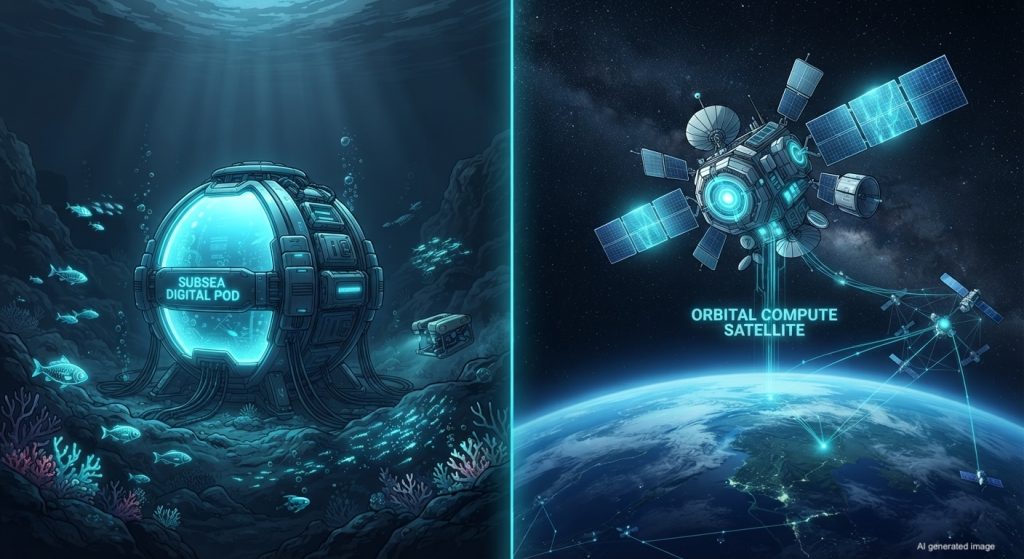
Could a sound you barely notice stop a computer at the bottom of the sea? And what happens to that same kind of delicate hardware when it’s strapped to a roaring rocket?
As engineers explore computing beyond conventional buildings, sound and vibration are becoming unexpected design challenges. The most interesting answers begin with human curiosity—and, increasingly, artificial intelligence.
The Discovery
The idea of an underwater data center began, in part, with someone who knew the sea.
In 2013, former Navy submariner and Microsoft employee Sean James proposed placing computing equipment underwater. His idea helped launch Microsoft’s Project Natick, which eventually placed 864 servers off Scotland’s Orkney Islands.
After two years on the seabed, the retrieved prototype showed a remarkably low server failure rate compared with a land-based control group. Surrounding seawater also offered a way to remove heat without consuming freshwater for cooling.
But the ocean holds an unexpected complication: Water carries sound remarkably well.
In 2024, researchers at the University of Florida and Japan’s University of Electro-Communications demonstrated that carefully directed underwater sound could interfere with hard drives and disrupt data-center operations. The very environment that helps cool equipment can also transmit damaging vibrations.
Look upward, and the challenge changes.
Sound cannot travel through the vacuum of space, but rocket launches expose delicate hardware to intense acoustic forces and mechanical vibrations.
In October 2026, Google’s Project Suncatcher launched an experimental AI-computing satellite into orbit, taking an important step toward understanding whether powerful computing systems can survive and function beyond Earth.
The Human–AI Partnership
The underwater vulnerability wasn’t discovered by an algorithm working alone.
A multidisciplinary research team led by University of Florida professor Sara Rampazzi brought together expertise in cybersecurity, computing, and robotics. The researchers investigated how acoustic waves could affect hard drives, storage systems, and the software managing computing resources.
They built experimental environments, deliberately introduced sound, and measured the consequences.
Then they turned to machine learning.
Their research, called AquaSonic, produced a machine-learning detection system designed to recognize acoustic attacks. Under the study’s reported test conditions, the model achieved a 98.2% true-positive detection rate with no false positives.
It was a promising laboratory result, not evidence of a fully deployed underwater defense system.
The researchers had identified a vulnerability, investigated its causes, and developed an AI-assisted approach to recognizing trouble before serious disruption occurs.
Meanwhile, Google’s Project Suncatcher team was exploring a different question: Could AI hardware withstand the journey into space?
Working with satellite manufacturer Planet, engineers subjected their equipment to rigorous vibration testing before launching a prototype into orbit on October 1, 2026.
On October 30, Google reported another milestone. An AI model running aboard the satellite had successfully generated a response to a prompt and transmitted it back to Earth.
In the ocean, machine learning demonstrated its potential as a protective tool. In orbit, AI became the technology engineers were learning how to operate in an entirely new environment.
Different challenges. Different applications. The same essential partnership between human ingenuity and artificial intelligence.
The Possibilities Ahead
Together, these discoveries offer a glimpse of where computing infrastructure might go next.
Underwater data centers could take advantage of natural cooling while reducing freshwater demands. But successful experiments don’t eliminate questions about maintenance, economics, or environmental effects.
The ocean is not an empty space waiting to be occupied.
Marine animals depend on underwater sound for communication, navigation, and survival. NOAA has documented how human-generated ocean noise can interfere with these essential activities. Any expansion of subsea computing must consider its potential acoustic impact on surrounding ecosystems.
Space presents an entirely different set of possibilities.
Solar-powered orbital computing could eventually supplement Earth-based infrastructure and process information closer to satellites collecting scientific data. Yet spacecraft must first survive launch vibrations, radiation, and extreme thermal conditions.
And there’s a surprising challenge: Although space is cold, its vacuum makes removing heat from powerful processors particularly difficult.
The U.S. Government Accountability Office cautioned in April 2026 that large-scale orbital data centers remain unproven, with cooling, costs, and orbital debris among the significant obstacles.
Could future machine-learning systems help engineers recognize early signs of equipment failure, predict maintenance needs, or improve the reliability of remote computing systems?
Possibly. But these remain opportunities for further research, not established solutions.
The next advances will require careful experimentation, environmental responsibility, and continued collaboration among researchers, engineers, and AI technologies.
From servers resting beneath the waves to processors circling Earth, the story isn’t simply about how far we can move our technology.
It’s about how thoughtfully we can develop it—and what becomes possible when human curiosity, scientific discovery, and artificial intelligence work together.
Sources & Further Reading
1. Microsoft Research — Project Natick: Phase 1 (2013–2015) The origins of Project Natick, including Sean James’s initial proposal and Microsoft’s earliest underwater computing experiments. Microsoft Research — Project Natick Phase 1
2. Microsoft — Project Natick Results (September 14, 2020) Research findings from the underwater data-center deployment near Scotland, including server reliability, cooling, and sustainability considerations. Microsoft — Underwater Data Center Research
3. IEEE Symposium on Security and Privacy — AquaSonic (May 2024) Sheldon, J., et al. AquaSonic: Acoustic Manipulation of Underwater Data Center Operations and Resource Management. Peer-reviewed research documenting acoustic vulnerabilities and the development of a machine-learning detection system. IEEE — AquaSonic Research Paper
4. University of Florida — Underwater Data Center Security (May 8, 2024) An accessible explanation of the research team’s experiments, acoustic vulnerabilities, and proposed machine-learning solution. University of Florida — Underwater Data Center Security
5. NASA Jet Propulsion Laboratory — Acoustic Noise Requirement (May 1996) NASA’s engineering guidance documenting the effects of launch acoustics and vibration on spacecraft structures and electronic components. NASA — Acoustic Noise Requirement
6. Google Research — Behind Project Suncatcher (September 24, 2026) An account of the engineering challenges involved in moving AI hardware into space, including vibration testing, radiation exposure, and cooling. Google — Project Suncatcher Engineering Research
7. Google Research — Project Suncatcher’s First AI Response (October 30, 2026) Google’s announcement confirming that its orbital prototype successfully executed an AI prompt and transmitted the generated response to Earth. Google — First AI Response From Orbit
8. U.S. Government Accountability Office — Data Centers in Space (April 28, 2026) An independent examination of the opportunities, engineering barriers, economic considerations, and environmental risks of orbital data centers. GAO — Science & Tech Spotlight: Data Centers in Space
9. NOAA Fisheries — Ocean Noise Research explaining how marine organisms depend on underwater sound and how human-generated noise can affect marine ecosystems. NOAA Fisheries — Ocean Noise