Above the Rainforest: How AI Helps Scientists See Individual Trees
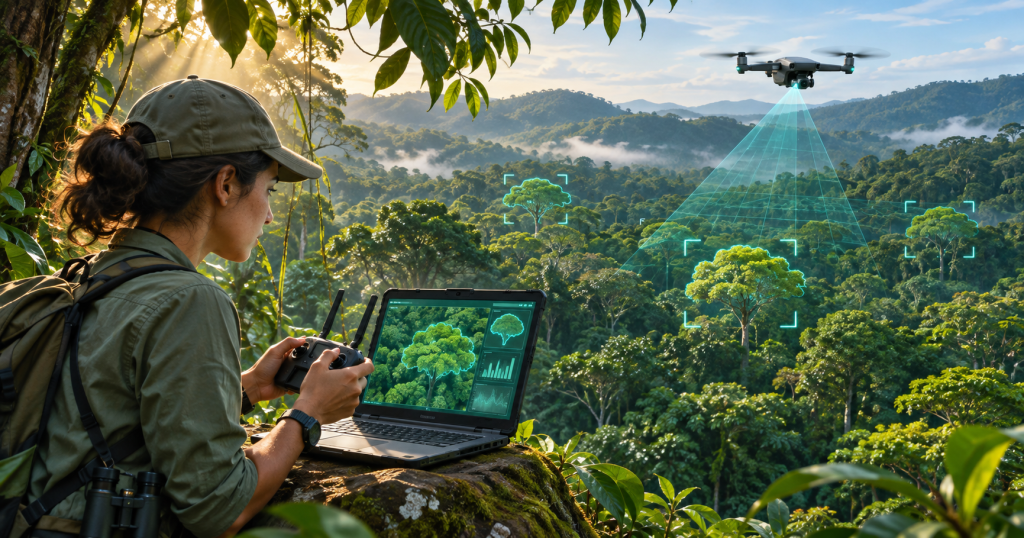
Imagine standing beneath the towering trees of a tropical rainforest, surrounded by thousands of leaves, branches, and vines. Somewhere high above you, an extraordinary world is unfolding—one that scientists have struggled to observe.
What if artificial intelligence could help researchers explore that hidden world, one tree at a time, without ever leaving the ground?
The Discovery
Tropical rainforests are among Earth’s most extraordinary ecosystems. They shelter remarkable biodiversity, influence global climate patterns, and store enormous quantities of carbon.
Yet scientists face a surprising challenge: identifying and monitoring individual trees can be remarkably difficult.
From the forest floor, the leaves, flowers, and fruits needed to distinguish one species from another may be hidden more than 100 feet overhead.
In October 2026, an international research team led by Professor Etienne Laliberté of the Université de Montréal published findings in Methods in Ecology and Evolution describing a new approach to this problem.
The researchers developed Harpia, an open-source system that automates detailed drone photography of rainforest canopies. Artificial intelligence can assist by identifying individual tree crowns in aerial images, helping researchers select which trees to examine more closely.
The drones then capture extraordinarily detailed photographs from approximately six meters above the treetops.
Across fieldwork in Panama, Ecuador, and Brazil, researchers completed 197 drone missions and photographed more than 24,000 individual trees.
In field demonstrations, a single operator could photograph up to approximately 300 tree crowns in one day.
The achievement is not simply taking pictures from above. It’s making detailed forest observations possible on a scale that was previously extremely difficult to achieve.
The Human–AI Partnership
What makes this discovery particularly interesting is the combination of artificial intelligence, field ecology, and human botanical expertise.
The process begins with researchers identifying an area of forest they want to study.
A drone first flies above the canopy, creating detailed maps of the landscape and the height of its trees.
AI-assisted image analysis can then help distinguish individual tree crowns within those maps. Researchers use this information to select locations for closer inspection.
Specialized software creates precise flight instructions, allowing the drone to return to selected trees and photograph their leaves, flowers, and fruits.
The images are detailed enough for trained botanists to identify many species by examining characteristics that would otherwise be difficult to see.
This distinction matters: the research does not demonstrate that AI can independently identify every tree species.
Instead, AI-assisted mapping and automated photography help scientists collect the detailed evidence they need.
Human researchers still determine which trees matter, identify species, interpret ecological changes, and decide what questions deserve further investigation.
The collaboration also builds something valuable for the future.
Each photograph identified by a botanical expert can become part of a reliable reference collection for training future AI species-recognition systems.
Human knowledge strengthens the technology, while the technology expands the reach of human observation.
The Possibilities Ahead
Understanding a rainforest requires more than knowing how many trees exist.
Scientists also need to understand which species are thriving, which are declining, and how forests respond to drought, heat, storms, and other environmental pressures.
The research team is connecting its technology with a broader international effort to investigate the health and mortality of large tropical trees.
These trees play an especially important role in forest ecosystems because of the substantial amounts of carbon they store.
Repeated drone surveys could eventually help scientists observe changes in individual trees over time.
Are certain species losing leaves during unusually dry seasons? Which trees recover after extreme weather? Are some more vulnerable than others?
These are questions the technology could help researchers investigate.
The possibilities extend to conservation organizations and local communities, which may eventually be able to monitor forests with greater detail and fewer resources.
But important work remains.
Drone operations require appropriate conditions, trained operators, and reliable positioning systems. Automated species identification also needs carefully verified training data.
The newly published research demonstrates improved data collection, not that AI has already prevented deforestation or restored damaged ecosystems.
Still, the opportunity is significant.
By making individual trees easier to observe, the technology could help scientists understand forests as living communities rather than distant green landscapes.
A rainforest is more than a collection of trees. It’s an intricate living system whose future depends on countless relationships we are still learning to understand. When AI helps scientists see those relationships more clearly, people gain another opportunity to protect what matters.
Sources & Further Reading
1. Original Peer-Reviewed Research
Laliberté, E., Caron-Guay, A., Le Falher, V., et al. (October 19, 2026). Seeing both the forest and the trees: An automated workflow for ultra-high-resolution drone imaging of tropical canopies. Methods in Ecology and Evolution.
DOI: 10.1111/2041-210X.70415
Read the original scientific study
2. University of Cambridge — Original Research Report
University of Cambridge, Department of Plant Sciences. (October 29, 2026). Monitoring forests with drones and AI.