Why Did the Car Stop? AI Helps People Understand Its Decisions
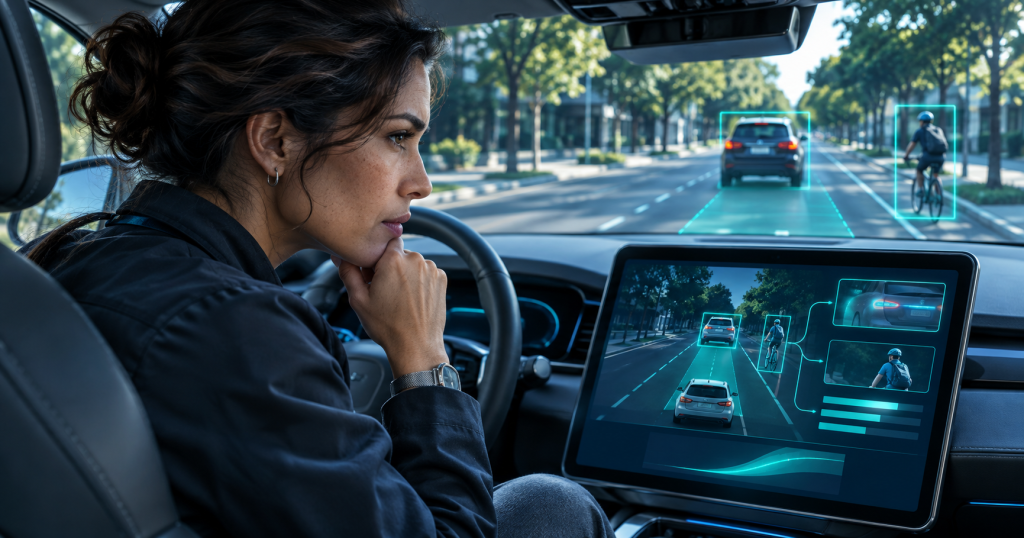
Imagine riding in a self-driving car when it suddenly brakes.
There’s no obvious obstacle. No pedestrian crossing the street. Nothing that explains why the vehicle stopped.
Would you trust it to continue?
Researchers at MIT are exploring a question that reaches far beyond autonomous vehicles: What happens when artificial intelligence becomes powerful enough to make decisions that people cannot easily understand?
The Discovery
Self-driving vehicles depend on sophisticated artificial intelligence systems that interpret their surroundings and determine how to respond.
Cameras and sensors collect information about nearby vehicles, pedestrians, road conditions, and other obstacles. AI processes that information and helps determine the vehicle’s next movement.
But there is a problem.
Many advanced AI systems operate as what researchers call black boxes. They can produce decisions without providing explanations that people readily understand.
That becomes particularly concerning when a vehicle behaves unexpectedly.
In September 2026, researchers from MIT and autonomous vehicle technology company Motional published a study in Nature introducing a method designed to address this challenge.
Their system, called the Concept-Wrapper Network, or CW-Net, helps translate an AI driving system’s decision-making into understandable concepts.
Instead of leaving a human operator wondering why a vehicle slowed down, the system can identify relevant conditions, such as approaching a stopped vehicle or traveling close to a cyclist.
The researchers tested the approach using an autonomous vehicle on a private test track and conducted additional evaluations with human participants.
Their findings demonstrated that explanations could improve people’s understanding of the vehicle’s behavior and their ability to anticipate its next actions.
The Human–AI Partnership
The breakthrough isn’t simply that AI can explain itself.
It’s that researchers designed the explanations to help people develop a more accurate understanding of what the vehicle is actually doing.
The research team, including MIT Professor Julie Shah and lead author Eoin Kenny, developed CW-Net to connect complex machine-learning decisions with recognizable driving situations.
The system identifies concepts that contribute to a vehicle’s decisions and presents them in a form humans can interpret.
Importantly, the explanations are designed to reflect the decision-making process itself rather than provide plausible-sounding descriptions afterward.
Researchers then investigated whether people could use that information effectively.
In one evaluation, nine experienced safety drivers and engineers and 30 participants without that expertise watched driving scenarios and considered why a vehicle had behaved unexpectedly.
After receiving explanations, eight of the nine experts and 27 of the 30 nonexperts demonstrated improvements in their understanding of the vehicle.
The team also conducted a larger experiment using recorded situations from public roads. Participants who received the explanations demonstrated better situational awareness during unusual driving events.
AI provided information about the factors influencing its behavior.
Human participants interpreted that information, reconsidered their assumptions, and became better equipped to anticipate what might happen next.
That’s a particularly meaningful form of collaboration: technology designed not just to act, but to help people understand its actions.
The Possibilities Ahead
The implications extend beyond autonomous vehicles.
As AI systems become more involved in transportation, healthcare, manufacturing, and infrastructure, people will increasingly encounter decisions influenced by complex algorithms.
Understanding those decisions may become essential for safe and responsible collaboration.
Consider an engineer investigating why an autonomous delivery vehicle stopped unexpectedly.
An explanation that identifies the relevant driving conditions could help the engineer distinguish a reasonable precaution from a system error.
Similar approaches might eventually help people monitor industrial robots, autonomous drones, or other technologies operating in complex environments.
But there are important limitations.
The research demonstrated improvements in human understanding and predictions. It did not establish that CW-Net reduces road accidents or makes autonomous vehicles universally safer.
The private-track tests and controlled evaluations also cannot represent every possible driving situation.
During the public-road data collection, the vehicle was operated manually while the experimental AI system ran in the background. The researchers subsequently used recordings to evaluate participants’ understanding.
Additional research will be necessary to understand how these explanations perform across different vehicles, road conditions, and longer-term real-world use.
There’s also a larger challenge: an explanation is valuable only if it accurately reflects the system’s behavior.
A confident but misleading explanation could create more danger than uncertainty.
The promise lies in developing technologies whose actions people can examine, question, and understand.
Trust should never depend solely on how intelligent a system appears. It should grow from evidence, transparency, and the ability to question its decisions. By helping people understand what AI is doing, researchers are exploring a future in which greater technological capability comes with greater human understanding.
Sources & Further Reading
1. Original Peer-Reviewed Research
Kenny, E. M., Dharmavaram, A., Lee, S. U., et al. (September 2, 2026). Explainable deep learning improves human mental models of self-driving cars. Nature, 657, 114–120.
DOI: 10.1038/s41586-026-10950-5
Read the original Nature research
2. MIT News — Original Research Report
Zewe, Adam. (September 2, 2026). System helps humans predict when self-driving cars will make mistakes.Massachusetts Institute of Technology.