Before Replacing Lead Pipes, Researchers Taught AI What Evidence Counts
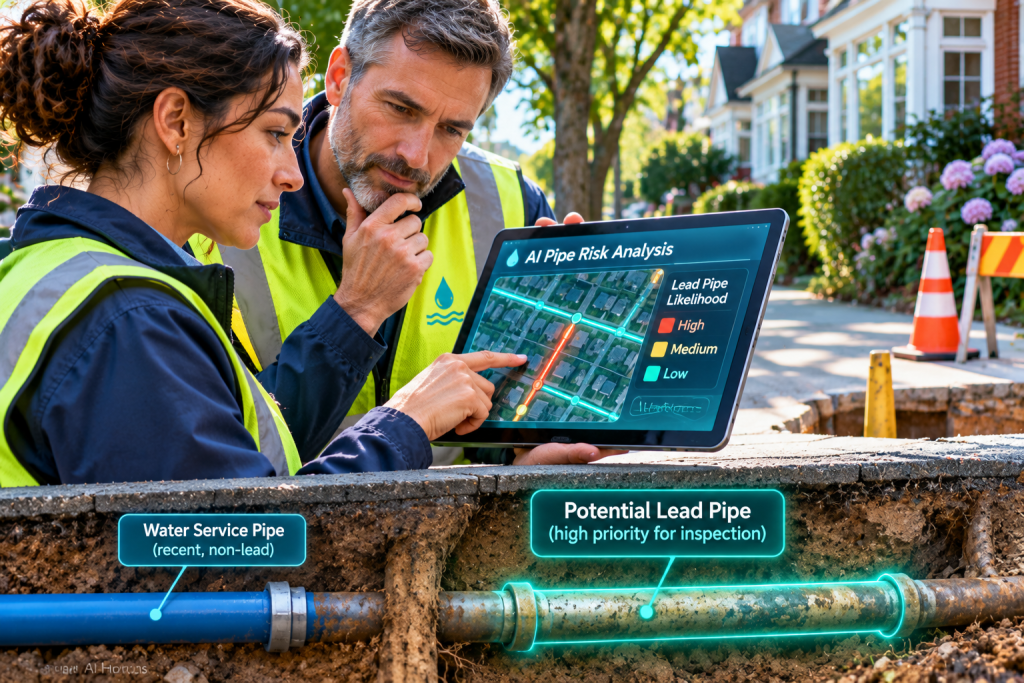
On an ordinary street, a water pipe beneath someone’s garden may have been there for generations. Water still flows through it, but nobody may know exactly what it’s made of.
Replacing old lead pipes is an important public health goal. Finding them is another matter.
Could artificial intelligence help locate these hidden hazards? Researchers in England discovered that the answer depends on something surprisingly human: knowing which evidence to trust.
The Discovery
Across older communities, water companies face a difficult problem. Some pipes carrying drinking water were installed decades ago, when lead was commonly used.
Today, lead is recognized as a serious health hazard. Replacing these pipes is important, but historical records are not always complete or reliable.
In November 2026, researchers from the University of Exeter and South West Water published a study in the Journal of Water Resources Planning and Management investigating whether machine learning could help identify properties likely to have lead service pipes.
Their findings revealed an important complication.
Previous approaches often trained AI using information that seemed relevant, such as water samples containing lead or historical records describing pipe materials.
But when the researchers compared these approaches against evidence from actual excavations and inspection holes, models trained on those indirect indicators performed no better than random chance at identifying lead pipes in the real-world dataset.
Models using observations from excavations provided a more reliable foundation.
The discovery was not that AI could magically locate every buried lead pipe.
It was that the quality of the evidence used to train AI can determine whether its predictions are useful at all.
The Human–AI Partnership
Imagine asking someone to identify every red house in a neighborhood using an old property directory.
The directory might describe how houses looked decades ago. Some entries could be incomplete. Others might be wrong.
Even a brilliant investigator would struggle to produce accurate results.
Machine learning faces a similar challenge.
The Exeter researchers evaluated different types of information used to teach AI which properties have lead service pipes.
Some information came from existing water-quality and asset records. Other evidence came directly from work crews investigating pipes in the ground.
The researchers compared how well models trained using these different sources could identify lead pipes in a real water network.
Their work demonstrated why direct physical observations matter.
Human engineers and field crews provide evidence of what is actually beneath a property. Data scientists determine how that evidence should be used, while machine learning identifies patterns that may help prioritize further investigation.
The collaboration also involves practical knowledge from South West Water, which understands the challenges of maintaining and improving an extensive water network.
AI contributes its ability to examine complex combinations of data.
People contribute something equally essential: the judgment to recognize when the information being analyzed is unreliable.
The Possibilities Ahead
South West Water has established a long-term ambition to eliminate lead pipes from its network by 2050.
Finding them efficiently is an important part of that effort.
Imagine a water utility trying to decide which streets should be investigated first.
Without dependable information, crews might excavate properties that have no lead pipes while overlooking others that need attention.
A properly trained machine-learning system could eventually help direct investigations toward locations where lead pipes are more likely to be present.
That could mean fewer unnecessary excavations, more efficient use of resources, and faster identification of pipes requiring replacement.
But the study also raises an important caution.
Machine learning cannot overcome unreliable training data simply by becoming more sophisticated. Utilities must first collect enough trustworthy evidence from field inspections.
The research does not establish how many additional lead pipes will be removed because of this approach. Nor does it demonstrate a measured improvement in drinking-water quality.
Those outcomes would require further operational evidence.
The immediate contribution is practical knowledge about building a more reliable prediction system.
And that lesson reaches beyond water infrastructure.
Whether AI is examining medical records, environmental conditions, or public infrastructure, its usefulness depends on the evidence people provide and their ability to question its conclusions.
There’s something fitting about this discovery. The pipes are hidden beneath our feet, but the path toward finding them begins with better information.
AI can help reveal patterns in that information. Human expertise ensures those patterns lead to responsible decisions—and, potentially, safer water for the communities they serve.
Sources & Further Reading
1. Original Peer-Reviewed Research
Hayslep, M., Farmani, R., Newstead, L., Keedwell, E., & Harvey, J. P. (November 10, 2026). Effectiveness of Different Ground Truths at Detecting Lead Service Pipes Using Machine Learning. Journal of Water Resources Planning and Management.
DOI: 10.1061/JWRMD5.WRENG-7717
Read the original peer-reviewed study
2. University of Exeter — Original Research Report
Sandes, D. (November 17, 2026). New research explores how machine learning can tackle lead pipe challenges.
Read the University of Exeter research report
3. South West Water — Research Partner
South West Water. (November 12, 2026). New research explores how machine learning can tackle lead pipe challenges.