Can AI Sensors Help Make Senior Living Safer?
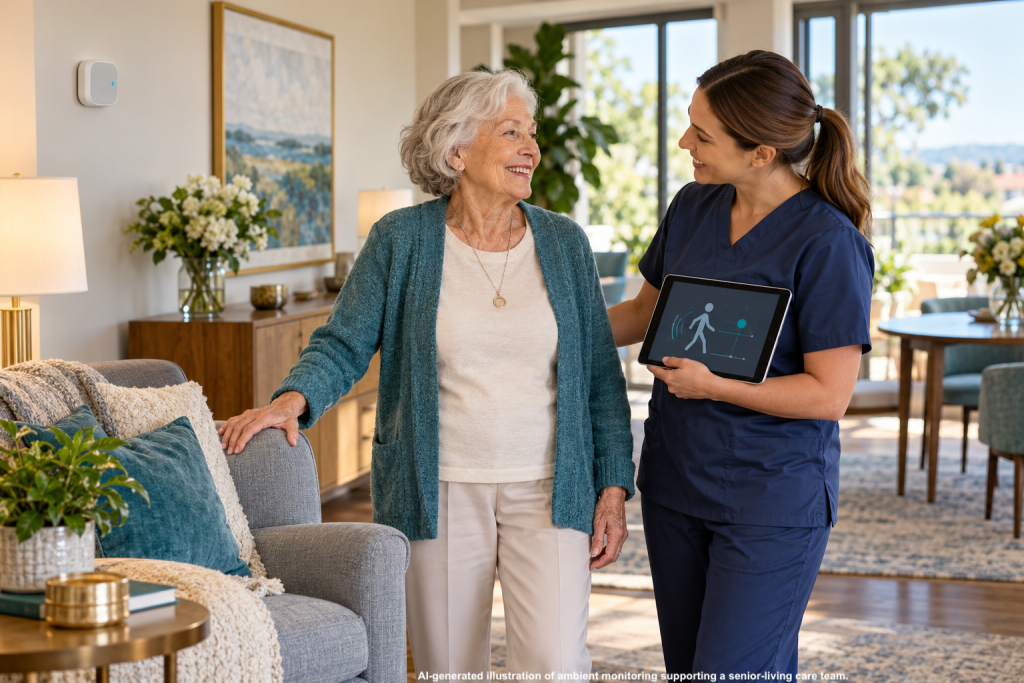
A fall can change an older adult’s life in seconds. Even when help is nearby, a delay in recognizing what happened can increase the risk of injury and complicate recovery.
Some senior-living communities are now using ambient sensors and artificial intelligence to help care teams recognize falls, unsafe movements, and signs that a resident may need assistance. Rather than relying solely on a wearable button—or waiting for someone to discover an incident—the systems monitor patterns within a room and alert staff when something appears wrong.
The promise is not care without people. It is a more responsive system that may help caregivers know where their attention is needed sooner.
How the system works
One example is a platform developed by Inspiren for assisted-living and memory-care communities. Its wall-mounted devices use computer vision to recognize movement while displaying residents as simplified, privacy-protected figures rather than conventional video images.
The system analyzes activity in real time. It can alert staff when it detects a possible fall or notices that a resident appears to be struggling with a movement, such as getting out of bed. Caregivers can then assess the situation, communicate with the resident, and determine what response is appropriate.
In bathrooms—where falls are especially concerning—the company uses radar and floor-level sensing intended to provide awareness without capturing a recognizable image of the resident.
What the AI contributes
Everyday movements can look surprisingly similar to a sensor. A person may be bending to retrieve something, kneeling to pray, exercising, or beginning to fall. Machine-learning systems are trained to distinguish among patterns like these and flag activity that may require attention.
The AI can watch continuously and notify staff more quickly than periodic room checks alone. It may also help care teams examine patterns over time, such as repeated difficulty standing or changes in movement that suggest a resident’s care plan should be reviewed.
The system does not diagnose the resident or decide what care should be provided. It identifies a possible concern. A caregiver brings the context, communicates with the resident, and makes the decision that follows.
What the early evidence suggests
Early reports from senior-living communities using these systems are encouraging. Forbes reported that one facility’s 10-month evaluation was associated with a 48 percent reduction in falls, 54 percent fewer hospitalizations, and response times that were 50 percent faster after the technology was introduced.
A separate preprint examined fall documentation before and after Inspiren’s system was installed in assisted-living facilities. The researchers reported improved documentation and examined whether better detection could support prevention of later falls and injuries.
These findings should be interpreted cautiously. The facility results have not been presented as an independent, randomized clinical trial, and the preprint had not undergone peer review when released. One of its two authors was affiliated with Inspiren. The evidence supports continued study—not a conclusion that the technology alone caused every reported improvement.
Safety, privacy, and dignity
Continuous monitoring creates a tension that should not be minimized. A technology may offer greater safety while also observing some of the most private moments in a person’s daily life.
Displaying a simplified figure instead of conventional video can reduce exposure, but it does not eliminate questions about consent, data storage, and who can access the information. Residents and families need clear explanations of what is being collected and how it will be used. Facilities also need procedures for false alerts, system failures, and situations in which a resident does not want to be monitored.
Dignity is not merely another feature to add to a safety system. It should help determine how the system is designed, introduced, and governed.
Why this matters
Caregivers cannot be everywhere at once, but older adults should not have to surrender their dignity in exchange for a faster response when they need help.
Used responsibly, AI-assisted monitoring could give care teams another source of timely information. It may help them recognize an emergency sooner, understand how an incident occurred, and notice changes that deserve a closer human look.
The goal is not to automate caring. It is to build a better system around the people who provide and receive it—one in which technology expands awareness while responsibility remains firmly human.
Sources
Highlight the Forbes article title and link it to:
https://www.forbes.com/sites/innovationrx/2026/09/09/the-550-million-startup-bringing-sensors-and-ai-to-senior-living-centers/
Highlight “Falls in Assisted Living Facilities: Can AI Improve Documentation and Reduce Injury?” and link it to:
https://doi.org/10.1101/2025.10.10.25337770
Highlight the systematic-review title and link it to:
https://doi.org/10.3390/s25216540