When AI Imagines an Object, People Help Make It Work
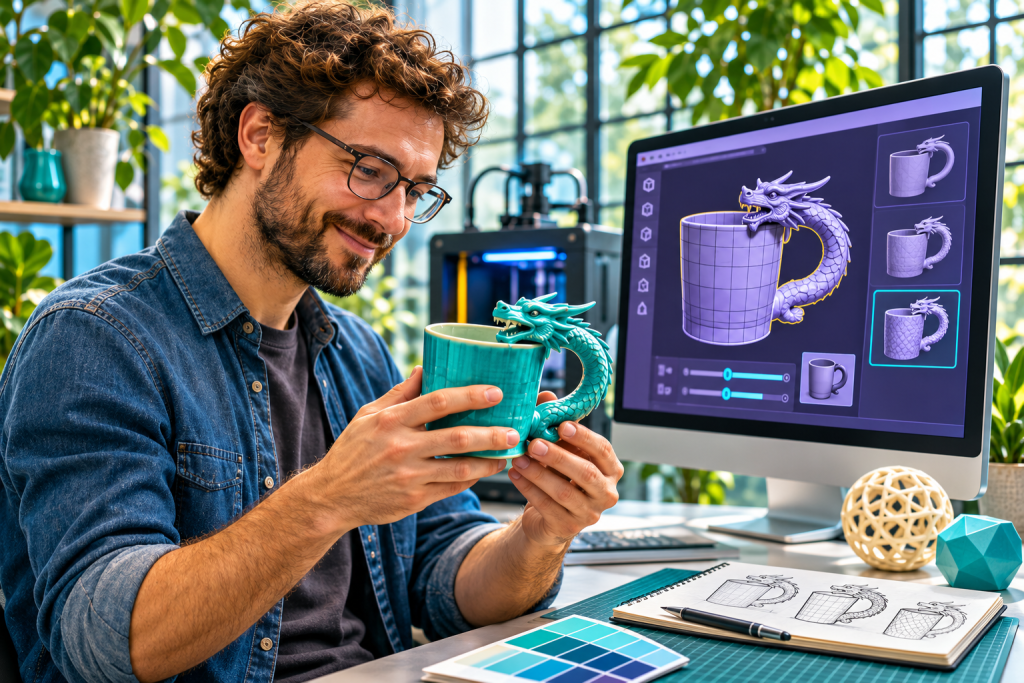
A mug with a dragon for a handle sounds delightful—until the computer gives it a sealed opening. Generative AI can dream up extraordinary objects, yet a beautiful digital shape is not always something you can print and use. Researchers have developed a design tool that makes fixing those mistakes part of the creative process, even for newcomers.
The Discovery
An idea becomes an object only when its shape works in the physical world. A hollow cup needs an opening. A phone stand needs enough thickness to support a device. And a decorative flourish must not destroy the object’s basic function.
Researchers from MIT’s Computer Science and Artificial Intelligence Laboratory, Google and Northeastern University developed InstructMesh to address this gap. Their paper was posted August 28, 2026, and the work is scheduled for presentation at the ACM UIST conference in November. The system takes a computer-generated three-dimensional model and lets a person repair a specific part without rebuilding the whole design.
To understand the problem, the team examined 120 AI-generated recreations of popular printable objects. Many had fabrication-related flaws, including blocked openings or unwanted pieces. In a small study with 12 people unfamiliar with 3D modeling, participants identified 90.4% of annotated flaws and repaired 89.7%, as assessed by an independent expert. The researchers also fabricated demonstration objects, including a whimsical dragon-handled mug. These results show promise in controlled tasks, not general success with every object or printer.
The Human–AI Partnership
The process starts with a human intention: perhaps a useful cup that also looks like a tiny dragon. A 3D-generating AI system produces a starting shape. The maker inspects it and selects the region that needs attention—such as a lid that should be open, or a wall that needs more material.
InstructMesh then offers two ways to communicate the desired change. A person can describe it in ordinary language or adjust sliders for a more precise edit. Behind the scenes, a language model interprets written instructions, while the 3D model and editing operations reshape the selected portion. A preview shows what will be added or removed before the change is applied.
Crucially, the system cannot decide what matters to the maker. That judgment remains with the person, who chooses what to change and whether to accept the result. In a separate study with 12 more novices, every participant preferred having both written instructions and sliders available. The finding points to collaboration rather than automation: AI supplies an editable starting point, while people supply purpose, imagination and the final say.
The Possibilities Ahead
Making a personalized object has often required learning specialized modeling software. An interface that accepts ordinary instructions could widen the circle of people who experiment with physical design: students building classroom prototypes, artists customizing everyday items, or makers adapting a simple tool for a particular grip or space.
The researchers demonstrated objects ranging from decorative glasses to a knee brace with a denim-like appearance. But a prototype is not proof that a printed device is suitable for medical use, and a visually repaired model may still fail under real physical stress. InstructMesh currently depends on people noticing flaws, works with relatively coarse geometric changes, and has not been comprehensively compared against conventional design tools. Its tests used a single underlying 3D generator.
The next challenge is to add stronger checks for structural strength and hidden defects, then evaluate designs across more materials, printers and real users. Better accessibility features would matter, too: the researchers note that their red-and-green preview could be difficult for some color-blind users.
What feels exciting is not instant manufacturing perfection. It is the prospect of making experimentation less exclusive while preserving the maker’s ability to question and refine an AI suggestion.
When a person can look at a flawed invention and say, “That isn’t quite what I meant,” creativity remains alive. The most useful role for AI may be to make that conversation with a design easier—and leave the decision in human hands.
Sources & Further Reading
1. Original research paper
Faraz Faruqi, Ahmed Katary, Demircan Tas, and colleagues. “InstructMesh: Selective Refinement of Generative 3D Models for Fabrication.” Research manuscript first posted August 28, 2026; associated with the ACM Symposium on User Interface Software and Technology, November 2026.
DOI: 10.1145/3830398.3830647
https://arxiv.org/html/2608.28534
2. Original institutional research report
Alex Shipps, MIT Computer Science and Artificial Intelligence Laboratory. “New tool lets users repair AI-generated 3D models, then fabricate them just the way they want.” October 1, 2026.
https://news.mit.edu/2026/instructmesh-tool-lets-users-repair-ai-3d-models-then-fabricate-them-1001