A Phone, a Cane, and AI Open New Paths to Independence
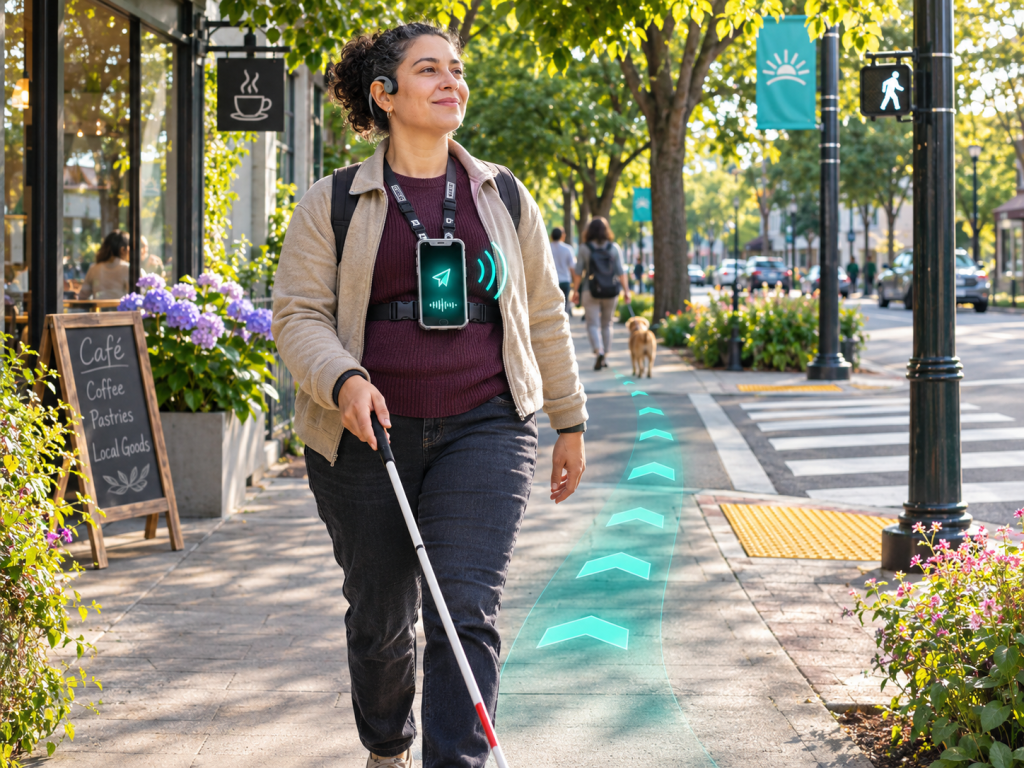
Imagine walking through an unfamiliar neighborhood without being able to see the sidewalk ahead.
You know your destination, but finding the safest route involves more than following directions. There are curbs, obstacles, intersections, and countless small decisions along the way.
What if your smartphone could become a more helpful navigation partner, providing guidance tailored to how you move through the world?
The Discovery
For people who are blind or have low vision, navigating unfamiliar outdoor environments can require considerable planning and attention.
Traditional navigation apps can provide directions, but they aren’t necessarily designed to identify safe walking paths or obstacles.
Researchers at Harvard University’s John A. Paulson School of Engineering and Applied Sciences have developed a smartphone application called Mobilio to address this challenge.
Their research, published August 24, 2026, in Nature Biomedical Engineering, describes a system combining artificial intelligence, smartphone sensors, and personalized audio guidance.
The technology helps users follow walking routes, remain on appropriate pathways, and identify obstacles.
In experiments involving 14 people who were blind or had low vision, researchers tested the application during outdoor navigation and obstacle-course activities.
When participants used Mobilio alongside a white cane, they completed an outdoor route approximately 13% faster than when using Google Maps with a cane.
In a separate indoor obstacle-course experiment, the system reduced contact with obstacles by approximately 41%compared with cane-only navigation.
These were encouraging results from a relatively small study.
The technology is still experimental, but the findings demonstrate how an ordinary smartphone could become a more capable accessibility tool.
The Human–AI Partnership
The inspiration behind Mobilio includes a deeply personal connection.
Lead researcher Raymond Liu has an older brother who is blind. That experience helped shape his interest in making independent navigation easier.
Rather than beginning with assumptions about what users needed, the Harvard researchers surveyed 112 people who were blind or had low vision.
Participants identified three important capabilities: directions to a destination, guidance along walking paths, and assistance avoiding obstacles.
The researchers then developed software combining information from a smartphone’s camera, GPS, motion sensors, and, when available, depth-sensing technology.
AI helps recognize elements of the environment, including sidewalks, crosswalks, and other walking surfaces.
The application translates this information into directional audio cues.
Instead of requiring users to continually interpret a map, the system produces personalized sounds indicating where to move.
The researchers also developed a method for adjusting the guidance according to how each person responds.
But the user remains responsible for navigating.
Mobilio is designed to work alongside a white cane, not replace it.
The collaboration extends beyond the software itself: researchers developed the technology, participants helped identify their needs and evaluate its usefulness, and AI processes environmental information to support the person’s decisions.
The Possibilities Ahead
The implications of this research extend beyond reaching a destination more quickly.
Independent mobility can influence how people participate in education, employment, community activities, and everyday experiences.
A navigation system that works on a widely available device could potentially make sophisticated assistance more accessible.
Imagine someone using personalized audio guidance to explore a college campus, walk to a neighborhood gathering, or navigate an unfamiliar shopping district.
These are potential applications, not outcomes demonstrated across all those environments.
Important limitations remain.
The study involved just 14 participants and a limited range of navigation tasks.
Although Mobilio reduced contacts with obstacles in the controlled indoor test, completing that obstacle course took participants longer. That tradeoff matters when evaluating practical usefulness.
The researchers also identified challenges involving difficult environmental conditions and surfaces that can be hard for computer vision to distinguish.
Additional testing will be needed across different neighborhoods, weather conditions, and real-world situations.
The technology must also be evaluated for accessibility, reliability, and how well it fits into people’s existing navigation habits.
Mobilio is a research prototype, not a replacement for established mobility techniques or professional orientation-and-mobility training.
Nevertheless, the results offer an encouraging direction.
When technology adapts to an individual’s needs rather than expecting everyone to interact with the world in the same way, accessibility becomes an opportunity for innovation.
A familiar route can offer comfort. An unfamiliar one can open new experiences.
The promise of Mobilio isn’t that AI will decide where someone should go. It’s that thoughtful technology may help more people make that choice—and explore the possibilities waiting beyond their usual paths.
Sources & Further Reading
1. Original Peer-Reviewed Research
Liu, R., & Slade, P. (August 24, 2026). Improving outdoor navigation for people with blindness using an AI-driven smartphone application and personalized audio guidance. Nature Biomedical Engineering.
DOI: 10.1038/s41551-026-01772-x
Read the original Nature Biomedical Engineering study
2. Harvard University — Original Research Report
Manning, A. J. (August 24, 2026). A Smartphone Navigation App for People with Blindness and Low Vision. Harvard John A. Paulson School of Engineering and Applied Sciences.
Read Harvard’s research announcement
3. Nature Portfolio — Research Summary
Nature Portfolio. (August 25, 2026). Engineering: AI smartphone app helps people with blindness navigate outdoors.